
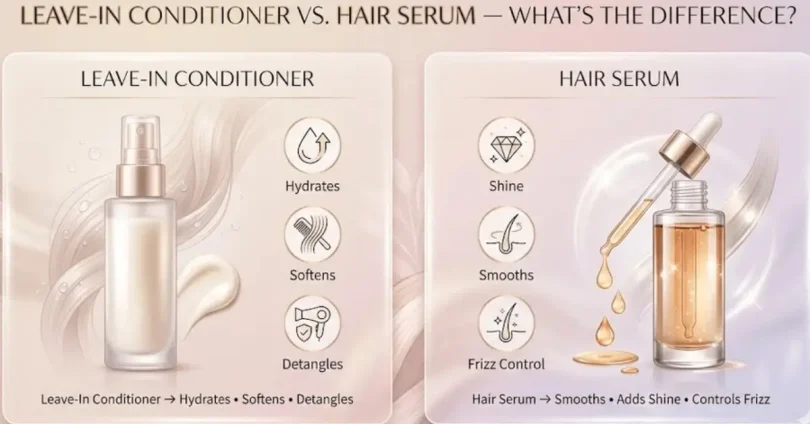

When comparing leave in conditioner vs hair serum, you might wonder which product your hair really needs. Both products can make your hair look smoother, softer, and healthier, but they work in different ways. A leave-in conditioner focuses on adding moisture, improving softness, and making hair easier to manage, while a hair serum mainly helps control frizz, add shine, and smooth the hair’s surface.
If you want to build a simple hair care routine, understanding the difference between these two products can help you choose the right one. Let’s look at how each product works, its benefits, and which option is best for your hair type.
What Is a Leave-In Conditioner?
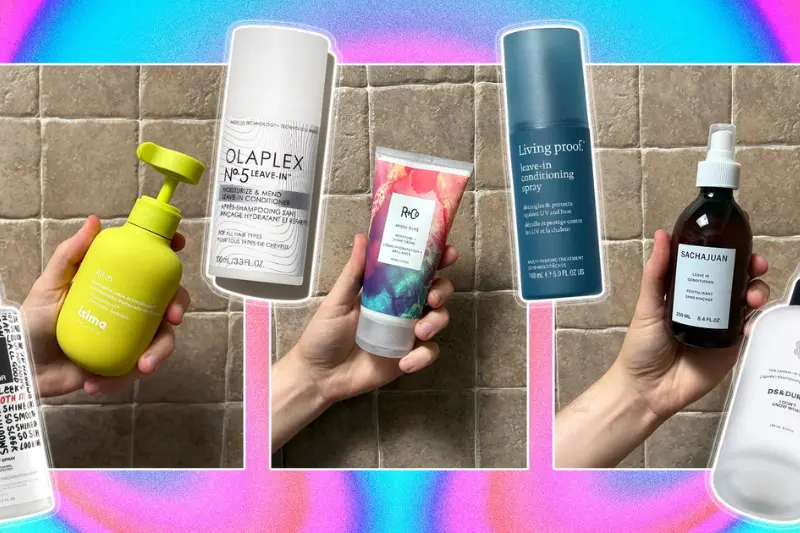
A leave-in conditioner is a hair care product that you apply after washing your hair and leave in without rinsing it out. Unlike a regular conditioner, it continues to provide conditioning benefits between washes.
Leave-in conditioners are designed to help your hair retain moisture, reduce tangles, and feel softer. They are especially useful if your hair is dry, curly, damaged, or difficult to manage.
Benefits of Leave-In Conditioner
Here are some of the main benefits of using a leave-in conditioner:
- Adds moisture: Helps dry hair feel softer and more manageable.
- Reduces tangles: Makes it easier to comb through knots without pulling or breaking your hair.
- Improves softness: Leaves hair feeling smoother and easier to style.
- Helps reduce breakage: Better lubrication can reduce friction while detangling.
- Supports curly hair: Helps curls feel more hydrated and easier to define.
- Improves manageability: Makes daily styling easier, especially for long or thick hair.
Who Should Use Leave-In Conditioner?
A leave-in conditioner can be a good choice if you have dry, curly, wavy, color-treated, or damaged hair. It may also help if your hair becomes tangled easily or feels rough after shampooing.
If your hair is fine or oily, you can still use one. Just choose a lightweight formula and apply a small amount to the mid-lengths and ends rather than your scalp.
What Is Hair Serum?
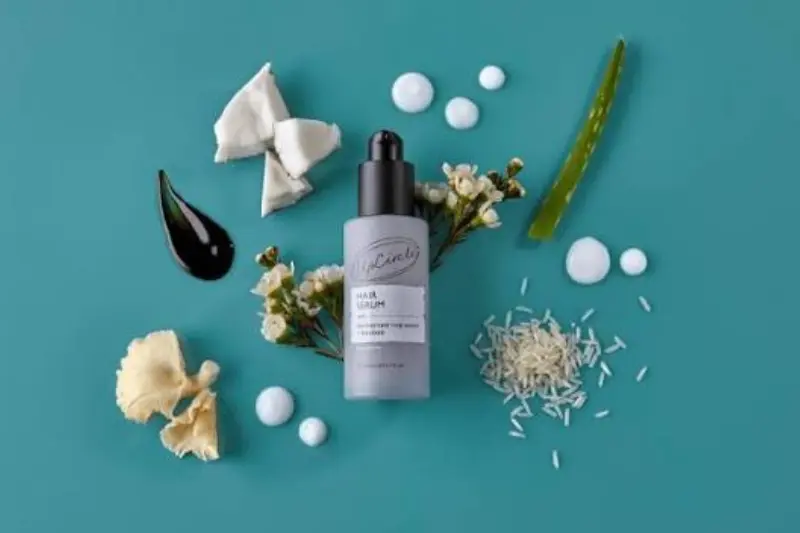
Hair serum is a styling and finishing product designed to smooth the hair’s surface, reduce the appearance of frizz, and add shine. Many serums contain silicones or other smoothing ingredients that help hair strands glide over one another.
Depending on the formula, a hair serum may also help protect against humidity, reduce friction, or provide some heat protection. However, not every serum offers heat protection, so always check the product label before using hot styling tools.
Benefits of Hair Serum
Hair serum offers several benefits for everyday hair styling:
- Controls frizz: Helps smooth flyaways and unruly strands.
- Adds shine: Makes dull-looking hair appear glossier.
- Smooths hair: Helps reduce the appearance of roughness.
- Improves styling: Makes hair look more polished and manageable.
- Reduces friction: Can help hair strands glide more easily, reducing tangling during styling.
- Helps with humidity: Some formulas help keep hair looking smoother in humid weather.
Who Should Use Hair Serum?
Hair serum is useful for people who struggle with frizz, dullness, flyaways, or rough-looking ends. It can work well for straight, wavy, and curly hair, depending on the formula.
If you have fine hair, choose a lightweight serum to avoid a greasy appearance. If your hair is thick, coarse, or very frizzy, a richer smoothing serum may work better.
Leave In Conditioner vs Hair Serum: Key Differences
Although these products can both improve your hair’s appearance, their main purposes are different.
| Feature | Leave-In Conditioner | Hair Serum |
| Main purpose | Conditioning and moisture | Smoothing and shine |
| Best for | Dry, tangled, or difficult-to-manage hair | Frizzy, dull, or flyaway hair |
| Texture | Usually a cream, lotion, or spray | Usually a lightweight liquid or gel-like formula |
| Detangling | Often helps significantly | May help reduce friction |
| Frizz control | Helps by conditioning hair | Often provides more immediate surface smoothing |
| Shine | Can improve softness and appearance | Often adds noticeable shine |
| Typical application | After washing, on damp hair | Usually on damp or dry hair, depending on the label |
| Scalp application | Usually avoid unless directed | Usually avoid unless specifically formulated for the scalp |
The easiest way to remember the difference is that leave-in conditioner helps condition your hair, while hair serum helps smooth its appearance.
Leave-In Conditioner vs Hair Serum: Which Is Better?
Neither product is automatically better than the other. The right choice depends on what your hair needs most.
Choose Leave-In Conditioner for Dry Hair
If your hair feels dry, rough, or difficult to comb, a leave-in conditioner is often the better starting point. It provides conditioning ingredients that help improve softness and manageability.
It can be especially helpful if you regularly wash your hair, have long hair that tangles easily, or use chemical treatments that leave your hair feeling dry.
Choose Hair Serum for Frizzy Hair
If your hair already feels reasonably soft but looks frizzy, puffy, or dull, a hair serum may be more useful.
A smoothing serum can help tame flyaways, improve shine, and make your hair look more polished. It is a practical option when you want your hairstyle to look smoother without adding a heavy conditioning product.
Choose Both for Dry and Frizzy Hair
If your hair is both dry and frizzy, you may benefit from using both products.
Apply a suitable leave-in conditioner first to damp hair, concentrating on the mid-lengths and ends. Then use a small amount of hair serum to smooth the surface and control flyaways.
You do not always need both products, though. If one product gives you the results you want, keeping your routine simple is perfectly fine.
Can You Use Leave-In Conditioner and Hair Serum Together?
Yes, you can use leave-in conditioner and hair serum together. In fact, combining them can be helpful if you want both conditioning and a smoother finish.
For the best results, follow these steps:
- Wash your hair: Use a shampoo suitable for your scalp and hair type.
- Apply regular conditioner: Rinse it out according to the product instructions.
- Use leave-in conditioner: Apply a small amount to damp hair, focusing on the lengths and ends.
- Detangle gently: Use your fingers or a wide-tooth comb to remove knots.
- Apply hair serum: Smooth a small amount over the mid-lengths and ends, following the product directions.
- Style your hair: Air-dry or use a suitable styling tool.
Start with small amounts of both products. Using too much can weigh down your hair and make it look greasy.
If you use a hair dryer or straightener, remember that a regular serum is not necessarily a heat protectant. Use a product specifically labeled for heat protection.
Which Product Is Better for Different Hair Types?
Your hair type can help you decide whether to use leave-in conditioner, hair serum, or both.
1. Dry Hair
Leave-in conditioner is generally the better first choice because it helps improve moisture retention, softness, and manageability. You can add serum if the ends still look rough or frizzy.
2. Curly Hair
Curly hair often benefits from leave-in conditioner because curls can become dry and tangled. A lightweight or curl-friendly serum can be added to help smooth the surface and improve shine.
3. Fine Hair
If you have fine hair, choose lightweight products. A spray leave-in conditioner can help with detangling without adding too much weight, while a lightweight serum can smooth the ends.
Avoid applying too much product, especially near the roots.
4. Thick Hair
Thick hair may benefit from both products. A leave-in conditioner can make it easier to detangle, while a smoothing serum can help control frizz and improve the overall finish.
Choose formulas that suit your hair’s texture rather than relying only on labels for thick hair.
5. Damaged Hair
If your hair is damaged from coloring, bleaching, or heat styling, a leave-in conditioner may help reduce friction and make it easier to manage. A serum may improve its appearance by smoothing rough-looking strands.
Neither product can completely repair severely damaged hair. Reducing heat exposure, trimming split ends, and using suitable conditioning treatments can also help.
6. Oily Hair
If your scalp becomes oily quickly, avoid applying rich products near the roots. Choose a lightweight leave-in conditioner or use serum only on the ends when needed.
Your scalp may need a suitable cleansing routine more than additional conditioning products.
You may also like to read this:
Shea Moisture Curl Shampoo Review: Is It Worth Buying?
Garnier Hair Food Mask Review: Benefits and Results
Coconut Oil vs Argan Oil for Hair: Which Is Better?
Rosemary Oil vs Castor Oil for Hair: Which Is Better?
Hair Mask vs Deep Conditioner: Which One Do You Need?
Leave-In Conditioner vs Hair Serum for Frizzy Hair
If frizz is your main concern, you may be wondering which product delivers better results.
Hair serum often provides more immediate smoothing because it helps coat the hair’s surface and reduce the appearance of flyaways. Leave-in conditioner can also help control frizz by improving softness and manageability.
The difference is that a leave-in conditioner focuses more on conditioning, while a serum often focuses more on the finished appearance.
If your frizz is caused by dryness, start with a leave-in conditioner. If your hair is already conditioned but still looks puffy, try a smoothing serum. If both problems occur together, you can use both in moderation.
Leave-In Conditioner vs Hair Serum for Curly Hair
Curly hair often needs extra conditioning because its shape can make it harder for natural scalp oils to travel along the hair strands.
A leave-in conditioner can help soften curls, reduce tangling, and improve manageability. A serum can help smooth the outer surface of curls and reduce the appearance of frizz.
For a simple curly hair routine, apply leave-in conditioner to damp hair and distribute it evenly. If needed, finish with a small amount of serum suitable for curly hair.
Avoid brushing dry curls aggressively, as this can increase frizz and disrupt your natural curl pattern.
Common Mistakes to Avoid
Even good hair products may not give you the results you want if you use them incorrectly.
Applying Too Much Product
Using too much leave-in conditioner or serum can make your hair feel heavy or greasy. Start with a small amount and add more only if necessary.
Applying Products Directly to the Scalp
Most leave-in conditioners and hair serums are intended for the hair lengths rather than the scalp. Applying them to your roots may cause buildup or make oily hair look flatter.
Always follow the instructions on your specific product.
Expecting Instant Hair Repair
These products can improve softness, manageability, and appearance, but they cannot permanently repair split ends or reverse all structural damage.
Choosing Products Without Considering Hair Type
A thick cream may work well for coarse curls but feel heavy on fine hair. Likewise, a very lightweight serum may not provide enough smoothing for thick, highly frizzy hair.
Choose products based on your hair’s needs, not just popularity.
Ignoring Heat Protection
Some serums contain heat-protective ingredients, but not all do. If you frequently blow-dry, curl, or straighten your hair, check that your chosen product is specifically designed for heat protection.
Tips for Getting the Best Results
If you want your hair to look healthier and feel easier to manage, follow these simple tips:
- Use leave-in conditioner when your hair needs extra conditioning.
- Use serum when you want to smooth frizz and add shine.
- Apply products mainly to the mid-lengths and ends.
- Start with a small amount to avoid buildup.
- Choose lightweight formulas if your hair is fine.
- Use a wide-tooth comb to detangle wet hair gently.
- Limit excessive heat styling and use a suitable heat protectant.
- Give your routine time to work, and adjust products if your hair becomes heavy or greasy.
You do not need a large collection of hair products to maintain a good routine. Choosing one or two products that meet your actual needs is often enough.
Frequently Asked Questions
1. Is leave-in conditioner better than hair serum?
Leave-in conditioner is generally better for conditioning, softness, and detangling. Hair serum is often better for smoothing frizz, adding shine, and controlling flyaways. The better option depends on your hair concerns.
2. Can I use hair serum instead of leave-in conditioner?
You can use serum instead if your main goal is smoothing and shine. However, serum may not provide the same conditioning and detangling benefits as a leave-in conditioner, especially if your hair is very dry.
3. Should I apply leave-in conditioner or hair serum first?
If you use both, apply leave-in conditioner first to damp hair, followed by a small amount of serum. This allows you to condition your hair before finishing with a smoothing product. Follow the instructions for your specific products.
4. Can I use leave-in conditioner every day?
Many lightweight leave-in conditioners can be used regularly, but the ideal frequency depends on your hair type and the product formula. If your hair starts feeling heavy or coated, reduce the amount or frequency.
5. Does hair serum help with hair growth?
Hair serum designed for styling does not directly promote hair growth. It may help reduce friction and improve the appearance of your hair, but this is different from stimulating new growth. Products marketed for scalp treatment may have different ingredients and purposes.
Conclusion
When comparing leave in conditioner vs hair serum, the main difference comes down to conditioning versus smoothing. Leave-in conditioner helps make your hair softer, easier to detangle, and more manageable, while hair serum helps reduce the appearance of frizz, smooth flyaways, and add shine.
If your hair is dry, curly, or difficult to manage, start with a leave-in conditioner. If your main concern is frizz or dullness, try a suitable hair serum. And if you struggle with both dryness and frizz, using a small amount of each may be the best approach.
The most important thing is to understand what your hair needs and choose products that work for your hair type. A simple, consistent routine can help your hair look smoother and feel healthier without making your daily hair care complicated.

[…] Leave In Conditioner vs Hair Serum: Which Is Better? […]
[…] Leave In Conditioner vs Hair Serum: Which Is Better? […]
[…] Leave In Conditioner vs Hair Serum: Which Is Better? […]
[…] You may also like to read this:Leave In Conditioner vs Hair Serum: Which Is Better? […]